


Falling in love with someone from a different faith is common today – but for Christian-Muslim couples, it often comes with a question neither partner expected to face: is our marriage even something we’re legally and religiously allowed to have? The answer depends on where you live, which branch of each faith you follow, and where you choose to get married. That’s exactly what we’ll cover here – including where Christian-Muslim couples can freely marry abroad.
What Is an Interfaith Marriage?
An interfaith marriage – also called an interreligious marriage or mixed marriage – is a union between two people who identify with different religions, and in most cases, each partner continues practicing their own faith after the wedding.
How common interfaith marriage is depends heavily on where a couple lives and which religions are involved. In secular countries, mixed marriages are becoming increasingly common – in some countries, they account for as much as 20-26% of all marriages – and rarely raise any legal questions. In many Muslim-majority countries, however, such marriages remain rare or are outright prohibited, which is exactly why so many Christian-Muslim couples end up planning their wedding abroad rather than at home.
What Does Islam Say About Christian-Muslim Marriage?
Islamic teaching on interfaith marriage isn’t symmetrical – it depends on which partner is Muslim. Under the traditional interpretation followed by most Islamic schools:
- A Muslim man marrying a Christian woman is generally permitted. Christians and Jews are considered «People of the Book» – a status the Quran treats differently from that of polytheists (Quran 5:5).
- A Muslim woman marrying a Christian man is, in most cases, forbidden under this same traditional view, based on interpretations of Quran 2:221, which advises against marrying «believers» to «unbelievers.»
This asymmetry has historically been justified by the idea that a Muslim husband is expected to allow his wife to keep practicing her own religion, while the religious environment of the household – and the faith the children are raised in – was traditionally expected to follow the father.
Not all Muslim scholars agree with this traditional position. A number of scholars associated with progressive and reformist Islam – including Khaleel Mohammed and Shehnaz Haqqani – argue that the same Quranic permission granted to Muslim men also extends to Muslim women. This remains a minority view, but it’s gaining ground, particularly among Muslim communities living in Western and European countries. In practice, this means a Christian-Muslim couple’s legal and religious options can look very different depending on which partner is Muslim, and which country’s laws they answer to.
What Does Christianity Say About Interfaith Marriage?
Unlike Islam, Christianity has no single, unified position on interfaith marriage – the rules and attitudes vary significantly by denomination:
- The Catholic Church allows a marriage between a Catholic and a non-Christian, but not automatically. The Catholic partner must obtain permission from their bishop – known as a «dispensation from disparity of cult.» Without it, the marriage isn’t recognized as valid by the Church, even though it may still be legally valid under civil law.
- Protestant denominations are divided. Some, citing 2 Corinthians 6:14 – traditionally read as a warning against a believer being «unequally yoked» with a non-believer – actively discourage or even prohibit interfaith marriage. Others take a more permissive stance, pointing to 1 Corinthians 7:12–16, where the apostle Paul addresses couples in which one spouse became a Christian after the marriage had already taken place, and encourages them to stay together rather than divorce.
- Orthodox churches generally require the non-Orthodox partner to be a baptized Christian for the marriage to be performed in the church, which in practice makes a Christian-Muslim union harder to formalize religiously than through civil law.
In other words, whether a Christian can marry a Muslim «in the church» depends less on Christianity as a whole and more on the specific denomination – and sometimes on the specific bishop or pastor involved.
Reasons for Difficulties
Religious rules are only half the problem. The other half is that many countries write these rules directly into civil law, leaving couples with no secular alternative.
In Israel, for instance, marriage can only be performed by religious authorities – civil marriage isn’t an option at all. This means an interfaith couple can’t simply sidestep the religious requirement: the state itself won’t register their marriage unless one partner converts. It’s a similar story in Lebanon, where marriage is governed entirely by the personal status laws of 18 officially recognized religious communities, with no civil alternative. In both countries, traveling abroad to marry has become so common among interfaith couples that it’s practically a tradition.
Beyond the legal barriers, family and community pressure often makes things harder still. Even where a marriage is technically possible, couples frequently face resistance from relatives, social judgment, or pressure to convert – stress that has nothing to do with the law and everything to do with reputation and belonging.
It’s this combination – no civil alternative at home, plus social pressure even where an alternative exists – that explains why so many Christian-Muslim couples choose to formalize their marriage in a country where neither issue applies.
Three Advantages of Registering a Christian-Muslim Marriage Abroad
- Many countries offer simplified marriage procedures for foreign nationals, regardless of their religious affiliation. This allows couples to avoid complex and lengthy bureaucratic processes.
- Registering a marriage in another country helps couples avoid conflicts and pressure from relatives and society – something that matters for interfaith couples not just legally, but emotionally. Family disapproval, unsolicited advice, or pressure to convert can create real psychological strain during what should be one of the happiest periods of a couple’s life. Marrying away from that pressure gives couples the space to build their relationship on their own terms – and to have those conversations with family later, at their own pace.
- A wedding abroad can turn into an unforgettable adventure, combining the legal formalization of the relationship with a honeymoon.


Countries Where You Can Organize a Muslim and Christian Wedding
| Country | Waiting period | Visa required? | Key documents |
| Cyprus | 15 days | No, for most Western nationalities | Passports, certificate of no impediment to marriage, copies of witnesses’ passports, divorce/death certificate (if applicable) |
| Georgia | Not required | No, for most nationalities | Passports, divorce/death certificate (if applicable) |
| Seychelles | 11 days | No, for any nationality | Passports, birth certificates, police character certificate, divorce/death certificate (if applicable) |
| Denmark | ~5–7 working days | Yes, Schengen area | Passport, certificate of marital status (issued within 4 months), proof of legal stay, divorce/death certificate (if applicable) |
| Czech Republic | No fixed period, slower process | Yes, Schengen area | Application form, certificate of legal capacity to marry, birth certificate, confirmation of legal residence (issued no more than 7 working days before the ceremony) |
For interfaith couples wishing to marry abroad, several countries offer convenient and flexible conditions for marriage registration. Let’s consider four popular destinations where Christians and Muslims can formalize their relationships as foreign citizens.
Cyprus
Cyprus is one of the most popular places for foreigners to get married. This country is known for its liberal laws and simple procedures for marriage registration, regardless of religious affiliation.
Registration Process:
- Submitting an application to the local municipality.
- Providing the necessary documents (passports, birth certificates, certificate of no impediment, copies of witnesses’ passports, divorce or death certificates of the previous spouse if applicable).
- Waiting 15 days after submitting the application (the process can be expedited for an additional fee).
- Holding the wedding ceremony at the municipality or a chosen venue.
Georgia
Georgia is becoming an increasingly popular destination for weddings among foreign couples. The laws of this country allow for quick and hassle-free marriage registration, regardless of the couple’s religious affiliation. Georgia also offers unique cultural traditions and picturesque views for wedding ceremonies.
Registration Process:
- Submitting an application at the House of Justice or via an online portal.
- Providing documents (passports, divorce or death certificates of the previous spouse if applicable).
- Holding the ceremony at the House of Justice or a chosen venue.


Seychelles
The Seychelles is an exotic and romantic destination for legalizing your relationship. The government of the Seychelles makes every effort to ensure that the marriage registration process for foreign citizens is as simple and convenient as possible.
Registration Process:
- Submitting an application at the Civil Status Office.
- Providing documents (passports, birth certificates, divorce or death certificates of the previous spouse if applicable).
- Holding the ceremony at a chosen venue.
Denmark
Denmark is famous for its flexible and quick marriage procedures, making it a popular destination for foreign couples, including interfaith couples. Danish laws allow couples of any citizenship and gender to marry, making it especially attractive for international unions.
Registration Process:
- The couple must submit an application to the local municipality (Kommune) or via an online portal.
- Providing documents:
- Passport from any country, additional requirements may apply to biometric passports.
- Certificate of marital status (depending on citizenship).
- Visa or residence permit in a Schengen country.
- Divorce or death certificate of the previous spouse (if applicable).
- Proof of residence.
- Document of the birth of joint children (if applicable).
- Holding the ceremony at the municipality or a chosen venue.
Czech Republic
The Czech Republic, with its medieval charm and Gothic architecture and straightforward marriage laws, is an ideal place for a wedding. This country also offers many unique locations for ceremonies, from ancient castles to sophisticated hotels.
Registration Process:
- The couple must submit an application to the local municipality (Obecní úřad) or the registry office (Matrika) in the chosen city.
- The following documents are required:
- Application form.
- Copy of the passport photo page and information on marital status from the internal passport.
- Birth certificate.
- Divorce or death certificate of the previous spouse (if applicable).
- Registration of marriage at the chosen venue.
Each of these countries offers favorable conditions for registering Muslim and Christian marriage. However, the requirements for necessary documents and entry into the country may change, so we recommend checking details with the embassy or specialists at the «Shu Wedding» agency if you choose Georgia for your wedding.
In addition to the requirements mentioned above, to register a marriage abroad, you will need to translate all necessary documents into English or the official language of the chosen country and have them notarized. In some cases, the document package may expand depending on various factors.
Legal status of Christian-Muslim marriage by tradition
| Tradition | Muslim man + Christian woman | Muslim woman + Christian man |
| Sunni Islam (majority view) | Generally permitted | Generally prohibited |
| Shia Islam (Twelver, e.g. Sistani) | Prohibited for permanent marriage (temporary marriage only) | Prohibited |
| Progressive/reformist Islam | Permitted | Permitted (minority view) |
| Catholic Church | Permitted with bishop’s dispensation | Permitted with bishop’s dispensation |
| Protestant denominations | Varies – permitted to discouraged, depending on the church | Varies – permitted to discouraged, depending on the church |
| Orthodox Christianity | Generally requires the non-Orthodox partner to be a baptized Christian | Generally requires the non-Orthodox partner to be a baptized Christian |
| Secular/civil law countries (e.g. Georgia, Denmark) | Permitted, religion irrelevant | Permitted, religion irrelevant |
Which Country to Choose for an Interfaith Marriage
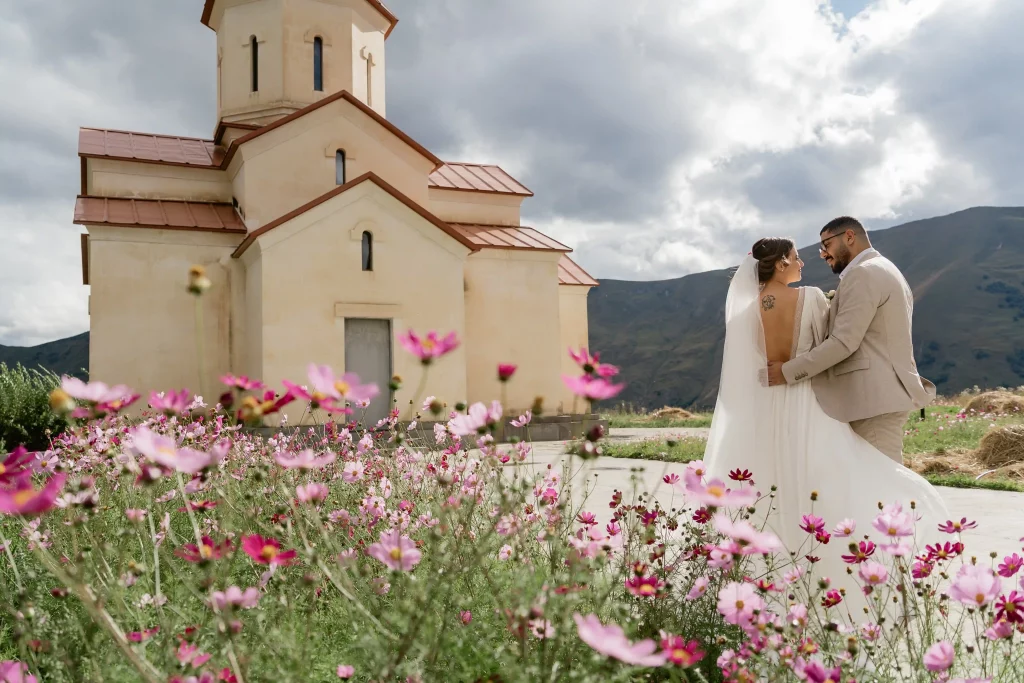
The ideal option for couples who want to marry without unnecessary bureaucratic delays is Georgia. Here, only a minimal set of documents is required, and the cost of all fees and wedding organization is significantly lower than in most countries worldwide. No visa is required for citizens of more than 90 countries, and the picturesque scenery and mild climate will make your wedding truly unforgettable.
In Georgia, marriage is a legal, not a religious, procedure. That means your faith doesn’t matter. What’s more, marriages concluded here are recognized worldwide. This means that even if you live in the UAE, you can legalize your marriage and be officially considered husband and wife.
How Much Does an Official Marriage in Georgia Cost for Interfaith Couples in 2026
| Service | Price | What’s Included |
| Shu Apostille | $435 | Application processing, witnesses, apostille within 4 working days (1-day express option), transfer |
| Shu Legalization | $490 | Same as above + passport translation and notarization, legalization within 8–11 working days, express delivery of the certificate |
| Shu Snowy Wedding | from $3000 | Official ceremony in Tbilisi, hair and makeup, decor, 6–7 hours of photography, bouquet, certificate preparation |
| Shu All Inclusive Wedding | from $2990 | Offsite official ceremony (mountains/lake), custom decor, hair and makeup, 6–7 hours of photography, certificate preparation |
| Shu Offsite Wedding | from $2950 | Offsite registration, planning, decor, makeup, 3 hours of photography, 3 hours of videography (camera + drone), transfer |
| Shu Elopement Wedding | from $3000 | Personalized ceremony, photography and videography, decor, coordination |
| Shu Wedding at Lopota Lake | from $3500 | Pier rental, ceremony decor, hair and makeup, 6 hours of photography, organization |
| Shu Wedding at Kvareli Lake | from $3000 | Pier rental, ceremony decor, hair and makeup, 6 hours of photography, organization |
The first two packages cover only the legal registration of the marriage (no ceremony). The rest include a full wedding ceremony along with document legalization.
Who These Services Are For
- Couples from the UAE, Kuwait, Qatar, and Saudi Arabia – countries outside the Hague Convention, where consular legalization is required instead of an apostille
- Couples from Lebanon, where an interfaith marriage cannot be civilly registered within the country without joining one of its 18 recognized religious communities
- Couples from Israel, where marriage can only be performed by religious authorities, making interfaith registration within the country effectively impossible
- Couples from Iran and Saudi Arabia, where interfaith marriage is strictly limited by Sharia-based family law
- Foreign residents of Gulf countries, who need a marriage recognized both where they live and in their home country


Marriage Registration Abroad and Legalization of Your Marriage Certificate
When you decide to get married abroad, it’s important to understand that your marriage won’t automatically be recognized in your home country. A foreign marriage certificate must go through a legalization process to become valid where you live or plan to reside. Legalization is what makes your marriage legally binding not just abroad, but also back home.
Why is this important? Legalization allows you to:
- officially confirm your marital status in your home country or country of residence;
- access all the legal rights that come with marriage (inheritance, property ownership, joint bank accounts, custody, visas, residence permits);
- ensure your marriage is recognized in legal matters, including divorce or inheritance disputes.
Without legalization, your marriage certificate will only be valid in the country where it was issued – and that could create serious difficulties in the future.
Two Ways to Legalize Your Marriage Certificate
1. Apostille.
This is the fastest and simplest option. Apostille is available for countries that are members of the 1961 Hague Apostille Convention. These countries have signed an international treaty that dramatically simplifies the process of validating foreign documents.
If you get married in Georgia, Shu Wedding can arrange an Apostille for your Georgian marriage certificate within just 4 business days. And if you’re in a hurry, we can even make it happen in as little as 1 day.
2. Consular Legalization.
For countries that are not part of the Hague Apostille Convention, consular legalization is required. This process is more complex and includes several steps:
- notarization of your certificate;
- certification by the Ministry of Justice;
- legalization by the Ministry of Foreign Affairs;
- final legalization at the consulate of your home country.
Countries such as Canada, China, the UAE, Kuwait, Qatar, and Saudi Arabia fall into this category. While this procedure is more time-consuming – usually 8-11 business days – you won’t need to stay in Georgia during this time. We’ll take care of everything for you and ship your fully legalized documents by express courier. Of course, if you prefer, you’re welcome to spend this time enjoying a magical honeymoon in Georgia.
A marriage certificate issued in Georgia is recognized worldwide. With Shu Wedding, you don’t have to worry about the bureaucratic side of things – we’ll handle all the paperwork, whether it’s an Apostille or consular legalization. That way, you can focus entirely on what matters most: celebrating your love story.
Getting married abroad should be joyful, not stressful. With our team, your marriage will be recognized anywhere in the world – and we’ll make sure the process is as seamless, fast, and worry-free as possible.
Frequently Asked Questions
Can a Christian marry a Muslim?
In most cases, yes – but the rules aren’t symmetrical. Under the traditional Sunni view, a Muslim man can marry a Christian woman, while a Muslim woman marrying a Christian man is generally not permitted religiously. Civilly, however, any Christian-Muslim couple can marry in a growing number of countries where marriage is a legal, not religious, procedure – including Georgia.
What does the Quran say about marrying a Christian or Jew?
The Quran (5:5) permits Muslim men to marry women from the «People of the Book» – Christians and Jews – treating them differently from polytheists. A separate verse (2:221) is traditionally interpreted as discouraging marriage between «believers» and «unbelievers,» which is the basis for restricting Muslim women from marrying non-Muslims.
Is interfaith marriage recognized by the Catholic Church?
Yes, but not automatically. A Catholic marrying a non-Christian, including a Muslim, needs permission from their bishop – known as a «dispensation from disparity of cult.» Without it, the Church doesn’t recognize the marriage as valid, even though it may still be legally valid under civil law.
Do children take the mother’s or father’s religion in an interfaith marriage?
There’s no universal rule – it depends on the couple, their families, and sometimes local law. Historically, many traditions expected children to follow the father’s religion, but in practice, most modern interfaith couples decide this themselves, and some choose to raise children with exposure to both faiths.
Which countries let Christian-Muslim couples marry without religious restrictions?
Countries where marriage is a civil, not religious, procedure – such as Georgia – allow Christian-Muslim couples to marry regardless of religion. Georgia is one of the fastest and least bureaucratic options: no waiting period, and no visa required for most nationalities.
Is a marriage certificate from Georgia recognized worldwide?
Yes. A Georgian marriage certificate is recognized internationally once legalized – either through an apostille (for Hague Convention countries) or consular legalization (for countries such as the UAE, Kuwait, or Saudi Arabia). Shu Wedding handles this process, ensuring the marriage is valid both in Georgia and in your country of residence.
We recommend
We organize weddings in Georgia , for any budget and wishes. With us, you won't have to think about how to organize your event or what documents you'll need. Georgia has simple laws and quick administrative resources, all you need for your dream wedding is your passports, we do the rest for you.